
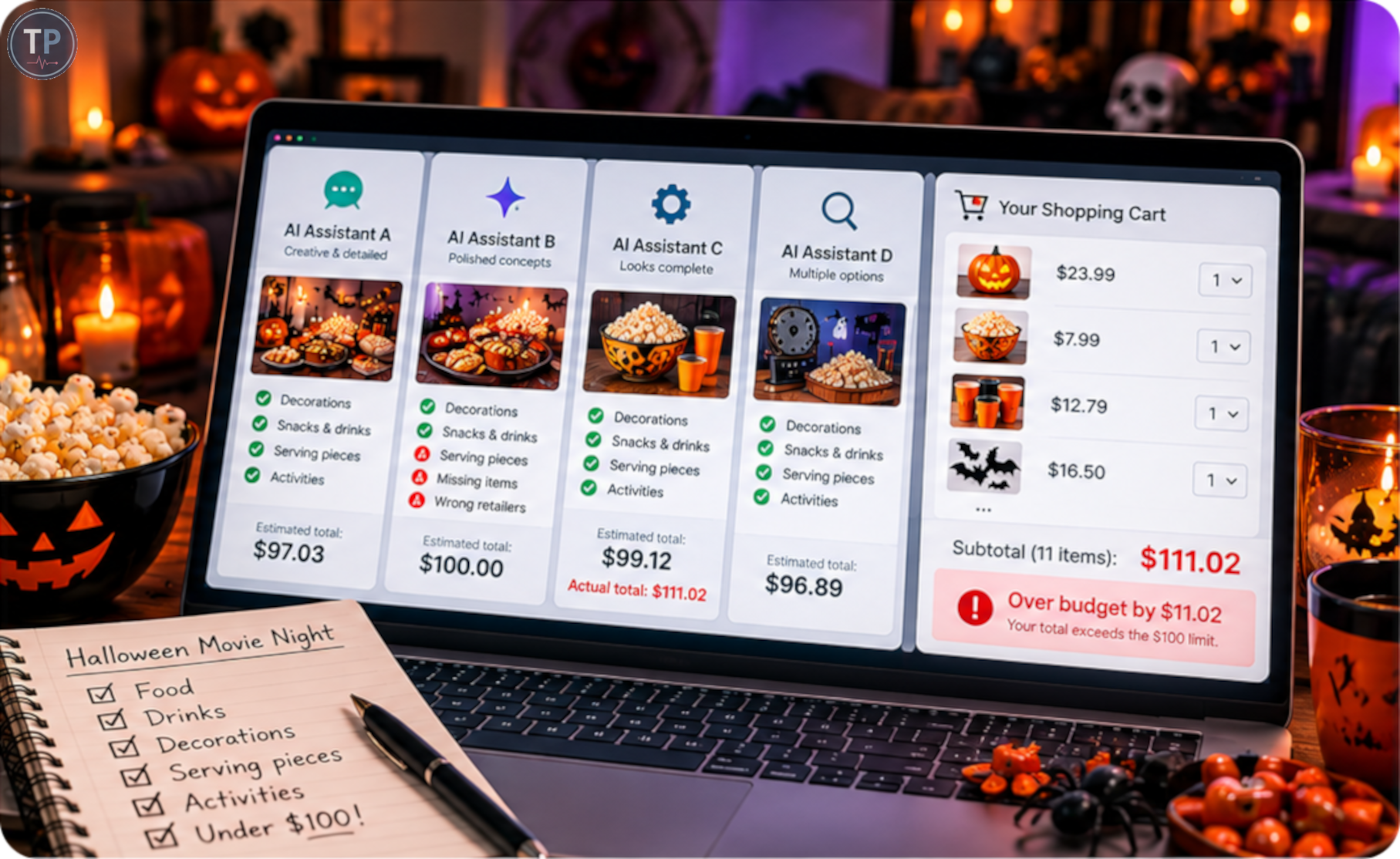
AI Said Our Shopping Cart Cost $99.12. It Was Actually $111.02.
⚡ WATCHING · THE PULSE
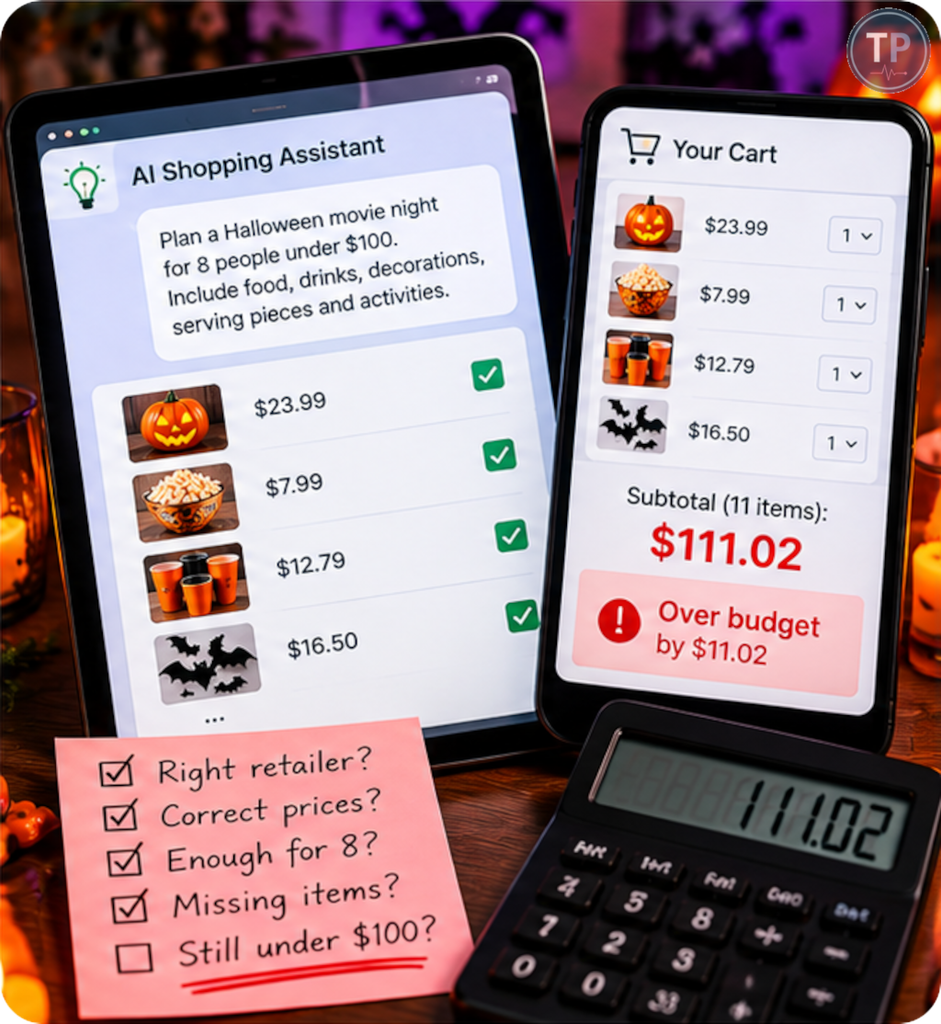
AI shopping assistants are getting very good at telling us what to buy. We wanted to know what happens when you stop asking for ideas and actually trust one with the shopping list.
So we gave some of the biggest AI assistants a pretty normal-sounding job:
Plan an impressive Halloween movie night for eight people. Give us the food, drinks, atmosphere, serving pieces and activities. Don’t leave anything out.
And whatever you do, stay under $100.
The results looked great.
There were glowing candles, spooky lights, popcorn bars, grazing boards, Halloween drinks, trivia games and enough clever presentation ideas to make you want to start shopping.
Then we added up the receipts.
One AI told us its basket cost $99.12.
It actually cost $111.02.
Another called its list “Amazon-only” while showing us shopping evidence from Walmart, Etsy and eBay.
Amazon’s own shopping experience realized its basket was over our $100 limit—and essentially handed the problem back to us to fix.
Walmart’s AI stayed comfortably under budget, but forgot some of the things we’d specifically asked it to buy.
THE THING THAT SURPRISED US
A lot of the recommendations were genuinely good.
That’s what makes this interesting. AI shopping isn’t useless. Far from it. It’s remarkably good at turning “I want to do something fun” into an organized plan.
The trouble starts when that plan has to survive contact with a real shopping cart.
Jump to: How We Tested · Quick Read · The Math · Amazon-Only · Consistency · Verification · Retailer AI · Was There a Best? · Before You Buy · Verdict
HOW WE TESTED
How We Tested the AI Shopping Assistants
On October 2, 2026, we gave ChatGPT, Gemini, Copilot and Perplexity the same assignment: create an impressive Halloween movie night at home for eight people with a maximum budget of $100.
They had to cover food, drinks, atmosphere, serving or presentation, and activities. We preferred purchases that could be reused after Halloween. Anything necessary to make the plan work had to be included unless it was a reasonable household or kitchen basic.
Then we ran it twice.
Round 1: Shop wherever you want.
Round 2: Same challenge, but every purchase had to be available on Amazon. No Walmart. No Target. No grocery stores. No Etsy.
We saved the answers for each of the AI shopping assistants before judging them. If an assistant produced multiple attempts, we kept them instead of quietly choosing the best one.
Then we checked the things that matter when you’re the person actually paying: math, budget, quantities, retailer, missing purchases, product claims and whether the basket could deliver the experience the AI promised.
Later, we put the same challenge directly to Amazon’s and Walmart’s own AI shopping experiences.
This wasn’t a laboratory test of every possible AI shopping task. It was one deliberately demanding consumer challenge designed to make the assistants juggle a lot of ordinary shopping constraints at once.
QUICK READ
What Happened
ChatGPT was one of the better experience planners. It stayed under budget in both rounds, although its Amazon-only total was off by $1.
Gemini came up with polished concepts, but the Amazon-only requirement caused trouble. One attempt surfaced banned retailers; another spent the entire budget without actually buying much of the food, drinks or activities its own plan described.
Copilot had the biggest math problem. Both of its supposedly sub-$100 baskets exceeded $110 when we added its own listed prices.
Perplexity was the arithmetic star: all six preserved basket totals added up correctly. But repeat runs gave us substantially different recommendations.
Amazon’s shopping AI had stronger access to actual merchandise, but still went over budget.
Walmart Sparky stayed well under budget and grounded its recommendations in Walmart products, but didn’t finish the assignment.
Different systems. Different failures. That turned out to be the story.
| Assistant | Math | Budget | Retailer / grounding | Completeness | What stood out |
|---|---|---|---|---|---|
| ChatGPT | 1 exact; 1 off $1 | Stayed under | Mixed verification | Strong | Good experience planning; small transactional error |
| Gemini | Mostly sound; one subtotal error | At/under stated cap | Amazon-only sourcing problems | Mixed | Polished concepts didn’t always survive the constraints |
| Copilot | Failed both rounds | Over both | Mixed | Mixed | Claimed sub-$100 baskets actually exceeded $110 |
| Perplexity | All preserved totals exact | Stayed under | Mixed verification | Generally strong | Strong arithmetic; substantial run-to-run variation |
| Amazon AI | Itemized total calculable | Over | Strong catalog context | Strong | Recognized its own budget violation but still returned the basket |
| Walmart Sparky | Visible basket checked | Well under | Strong Walmart grounding | Failed | Left $28.79 unused while required pieces were missing |
First, Apparently We Need to Check the Math
Copilot gave us the example we couldn’t ignore.
Its first Halloween basket looked like it had threaded the needle beautifully: $99.12.
Perfect. Ninety-eight cents to spare.
Except the prices Copilot itself listed totaled $111.02.
COPILOT’S OWN LISTED PRICES
- Vinkor flameless candles — $23.99
- Coogam 3D Halloween bats — $7.99
- DII Gothic lace tablecloth — $16.50
- Uutvery witch-hands candy bowl — $9.78
- Utz Witch’s Brew party mix — $3.29
- DIY popcorn bar — $7.50
- Brownie bites — about $4.00
- Zorvinex reusable pumpkin cups — $4.19
- KICHOUSE 5-pack Halloween drink pouches — $12.79
- DIY signature drink — $5.00
- JOYIN Halloween punch balloons — $15.99
Actual total: $111.02.
No obscure shipping charge. No tax surprise. No price changing between searches.
We simply added its own numbers.
That put the basket $11.02 over our hard budget and made Copilot’s displayed total wrong by $11.90.
Round 2 wasn’t better. Copilot gave one total as $97.79 and another as $97.78. Its seven listed purchases totaled $112.78.
ChatGPT’s mistake was much smaller. Its Amazon-only “Candlelit Haunted Cinema” claimed $97.03. The listed purchases totaled $98.03.
Still under budget. Still a usable plan. Still wrong.
Gemini had a smaller bookkeeping problem of its own. In one Amazon attempt, its merchandise subtotal was misstated by $0.96, although the estimated tax and final $99.97 total corresponded to the correctly added merchandise prices.
Perplexity, meanwhile, got the arithmetic right in all six preserved plans.
Passing the arithmetic test doesn’t necessarily mean passing the shopping test.
That’s worth remembering because AI shopping errors don’t always arrive wearing flashing warning lights. Sometimes everything looks completely reasonable.
Microsoft’s own guidance for shopping with Copilot makes essentially the same point from the other side: the company tells users that Copilot can make mistakes and says key product information, pricing and purchase terms should be verified on the retailer’s site.
Then “Amazon-Only” Stopped Meaning Amazon-Only
Round 2 was deliberately simple: every purchase had to be currently available on Amazon.
We even spelled it out: No Walmart. No Target. No grocery stores. No Etsy.
Gemini’s first attempt still surfaced shopping evidence from Walmart and eBay, while several grocery recommendations weren’t specific Amazon products at all.
So it tried again.
Attempt two landed on a suspiciously satisfying number: $100.00 exactly.
WHAT $100 ACTUALLY BOUGHT
- 24-pack amber tealight holders — $36.99
- Organic Grade 90 cheesecloth — $12.99
- 20-pack black plastic serving trays — $47.23
- Amazon Saver popcorn kernels — $2.79
Total: $100.00.
That’s it.
Meanwhile, the party Gemini described still included a Gothic Graze Board, Vampire Elixir and movie trivia. None of those things were actually in the final basket.
More importantly, the shopping list contained no purchased drinks, no meaningful meal or graze-board ingredients, and no activity purchase even though all three were explicit parts of the assignment.
TRENDPULSE TAKE
An AI shopping assistants can satisfy the shape of a request without actually satisfying the request.
The total said $100. The prose sounded complete. The shopping list wasn’t.
Perplexity Found a Different Problem
Perplexity did something none of the others managed across our preserved runs: the math kept working.
SIX PRESERVED RUNS
Round 1: $97.35 · $92.68 · $94.50
Amazon-only Round 2: $99.10 · $89.89 · $96.89
We checked all six. They added up.
But the three Amazon-only answers span $9.21, and it wasn’t simply the same basket with prices moving around.
The products changed. The party changed. The priorities changed.
One version gave us a Halloween projector, cocoa station and individual popcorn bowls. Another bought a tiered serving stand, silicone popcorn popper, Coke and a Hocus Pocus rental. Another went with blacklights, microwave popcorn, Dr Pepper and a movie card game.
Were they bad answers? No. Some were quite good.
But that’s exactly the point.
When an AI shopping tool presents a recommendation confidently, it’s easy to assume it has somehow determined the answer. Run the same problem again and you may discover it generated an answer.
That’s a meaningful distinction when you’re deciding what to buy.
The Recommendations Weren’t All Wrong. That’s the Important Part.
This isn’t a “look how stupid AI is” story. That wouldn’t match what we found.
Some products and prices survived our independent checking. Some baskets were coherent, creative and genuinely useful. Others couldn’t be reproduced with the same confidence.
Online prices change. Inventory changes. Search results change. Unverified does not automatically mean false.
But “currently available,” “in stock” and “verified live” are factual shopping claims. They need to survive being checked.
That isn’t just our caution. OpenAI’s own shopping research guidance tells shoppers to confirm final prices and availability with the retailer before buying.
Good transactional information and questionable transactional information can arrive in exactly the same confident voice.
Surely the Retailers’ Own AI Would Have an Advantage
We wondered the same thing.
A retailer’s AI operates much closer to its own catalog. It should know what the store sells, what things cost and whether they’re available.
That advantage showed. Product grounding was clearer.
It didn’t solve everything.
Amazon: It Knew It Was Over Budget
Amazon’s shopping experience put together a fairly complete Halloween plan and initially estimated the basket at roughly $94–$96.
The itemized products totaled $104.50.
Then came the fascinating part: Amazon’s AI noticed.
It acknowledged that the basket was over our $100 maximum and suggested that we remove or replace something.
TRENDPULSE TAKE
The assistant understood the rule, understood that it had broken the rule, and made fixing its mistake our job.
It also told us to use a silicone popcorn popper “which you already own.” We had never said we owned one.
This matters beyond one Halloween test. Amazon describes its current AI shopping assistant as capable of product research, comparisons, price tracking and increasingly agentic shopping actions. The closer AI gets to acting instead of merely suggesting, the more consequential a small mistake becomes.
Walmart: Plenty of Money Left, but the Party Wasn’t Finished
Walmart Sparky went the opposite direction.
Its main selections totaled about $71.21. That’s $28.79 still sitting on the table.
Great—except we had a popcorn maker with no popcorn kernels, one 25.4-ounce bottle of sparkling cider for eight people, very little substantial food beyond candy, and no activity despite activities being one of the explicit requirements.
Amazon completed more of the experience and overspent. Walmart protected the budget and left parts of the experience unfinished.
WHAT RETAILER ACCESS ACTUALLY FIXED
Being connected to the store helped the AI find products. It didn’t necessarily help it reason through the entire shopping job.
So Which AI Shopping Assistant Won?
We’re not naming one.
That’s deliberate.
We decided what we would examine before comparing the results, but we didn’t assign numerical weights to those factors.
If we invented a scoring system after seeing the answers, we could make math worth 30%, completeness 20%, verification 25% and keep nudging the numbers until whichever assistant we liked came out on top.
That’s not a test. That’s decorating a conclusion.
- ChatGPT was good at designing the experience, with a small Round 2 arithmetic miss.
- Gemini produced polished ideas but struggled when retailer compliance became part of the job.
- Copilot produced our clearest hard-budget failures.
- Perplexity had consistently accurate arithmetic in our preserved runs, but considerably different recommendations from run to run.
- Amazon knew its products better but still violated the budget.
- Walmart grounded products well but didn’t complete the assignment.
There wasn’t one universal failure, and there wasn’t one assistant that proved best at everything.
The useful question isn’t “Which AI won?” It’s “Which part of the shopping job are you trusting AI to do?”
BEFORE YOU BUY
Before You Let AI Shop for You
Our experiment didn’t convince us to stop using AI shopping assistants. It convinced us they’re already useful.
Just don’t confuse useful with ready to run the checkout unsupervised.
- Add the basket yourself. Yes, really.
- Check the retailer. Amazon-only should mean Amazon-only.
- Check quantities. A real product can still be nowhere near enough.
- Look for missing pieces. Compare the shopping list with the experience the AI promised.
- Open the listing. Verify price, availability and seller before checkout.
- Check whether the price is actually good. “Today’s price” and “good deal” are not synonyms.
It takes a few minutes. Our $99.12 basket that became $111.02 is a pretty good argument for spending them.
If you’re planning Halloween rather than testing AI, our Halloween decorating guide takes the opposite approach: start with what you already own, build a few strong scenes, and only buy for the jobs that are actually missing.
TRENDPULSE VERDICT
AI Can Help You Shop. Don’t Hand It the Checkout Yet.
What surprised us wasn’t how badly these assistants performed.
It was how useful they could be right up until something went wrong.
Give AI a vague idea and it can turn it into a coherent shopping plan remarkably quickly. It can suggest things you hadn’t considered, organize a complicated purchase and turn “Halloween movie night” into lighting, food, drinks, presentation and entertainment in seconds.
That’s useful.
But TrendPulse isn’t interested in whether AI can make a pretty shopping list. We wanted to know whether that list still worked when somebody actually had to buy it.
That’s where the boring questions suddenly matter: Is that really the current price? Is it actually sold by the retailer you requested? Did everything make it into the basket? Is there enough for everyone? Does the total fit the budget?
Those questions aren’t nearly as exciting as glowing pumpkins and Vampire Elixir.
They’re also the questions that determine what comes out of your bank account.
For now, we’d absolutely use AI to help design the shopping trip.
We just wouldn’t hand it the checkout button.
AI shopping is already useful. Just don’t hand it your $100 and assume you’ll get change.
WHAT WE’RE WATCHING NEXT
The Bigger Test Is Holiday Shopping
We used Halloween because it forced the assistants to juggle products, quantities, food, décor, activities and a hard budget all at once.
But Halloween isn’t really the bigger story.
Holiday shopping is coming.
Gift lists. Black Friday deals. Price comparisons. Stocking stuffers. “Buy everything I need for Thanksgiving.” Complete Christmas shopping plans.
AI is moving steadily closer to the point where a recommendation becomes a purchase.
And after this experiment, there’s one question we’re watching:
What happens when we stop asking AI what we should buy—and start trusting it to actually shop?
That’s the pulse we’re watching next.





One Comment